
Understanding AASB S2: Australia's Climate-related Financial Disclosures
AASB S2 is the Australian standard for mandatory climate-related financial disclosures. Since 1 January 2025, large Australian entities that prepare annual financial reports under the Corporations Act 2001 have been phasing in climate statements prepared under AASB S2. Medium-sized entities followed from July 2026, and smaller ones start from July 2027. Private ownership does not take a company out of scope, so many private equity-backed portfolio companies are already reporting or about to start.
This article covers the portfolio companies that are in scope, when to report, what they must disclose, and what investors, customers and auditors will expect.
Key takeaways
- Portfolio companies can be in scope. AASB S2 reporting applies to companies that must prepare annual financial reports under Chapter 2M of the Corporations Act, including large proprietary companies, and that meet the size, emissions or asset thresholds. Private equity funds themselves usually aren’t caught but GPs should check with in house counsel to ensure that this is the case.
- Group 2’s first reporting years have begun. Group 1 started in January 2025, Group 2 in July 2026 and Group 3 starts in July 2027.
- Two scenarios are mandatory. Companies must assess resilience at 1.5°C and well exceeding 2°C (The Australian Securities and Investments Commission (ASIC) treats this as 2.5°C or higher).
- Scope 3 follows in Year 2. Scope 1 and 2 emissions are required from the first report.
- Reasonable Assurance is expected by Year 4. Methods should be repeatable from the first report.
- Out-of-scope companies are likely to get data requests. Customers, lenders and owners may ask for climate data from key suppliers to ensure they can meet regulatory reporting requirements.
- The rules are still changing. Group 3 thresholds and assurance requirements are proposed (as of November 2026).
The Australian context
Built on the TCFD recommendations, IFRS S2 is the baseline for climate disclosure rules in a growing number of jurisdictions, including Hong Kong, Singapore and Australia. AASB S2 is based on IFRS S2 and keeps its paragraph numbering, with modifications for the Australian legal context.
AASB S2: Implementation Timeline
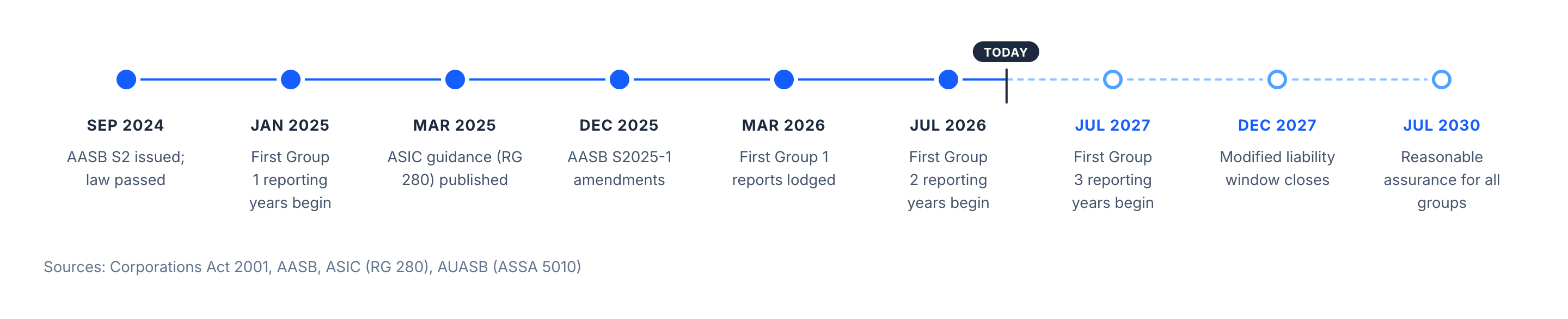
Mandatory climate-related financial disclosure was introduced into Chapter 2M of the Corporations Act 2001 by the Treasury Laws Amendment (Financial Market Infrastructure and Other Measures) Act 2024, passed in September 2024. In-scope entities must prepare an annual sustainability report, lodged alongside their financial report, containing climate statements prepared in accordance with AASB S2 (issued by the Australian Accounting Standards Board on 20 September 2024), any notes, and a directors’ declaration. AASB S1, the general sustainability standard, is voluntary. ASIC administers the regime and has published guidance in Regulatory Guide 280 Sustainability reporting (RG 280).
How does AASB S2 compare with global climate reporting frameworks?
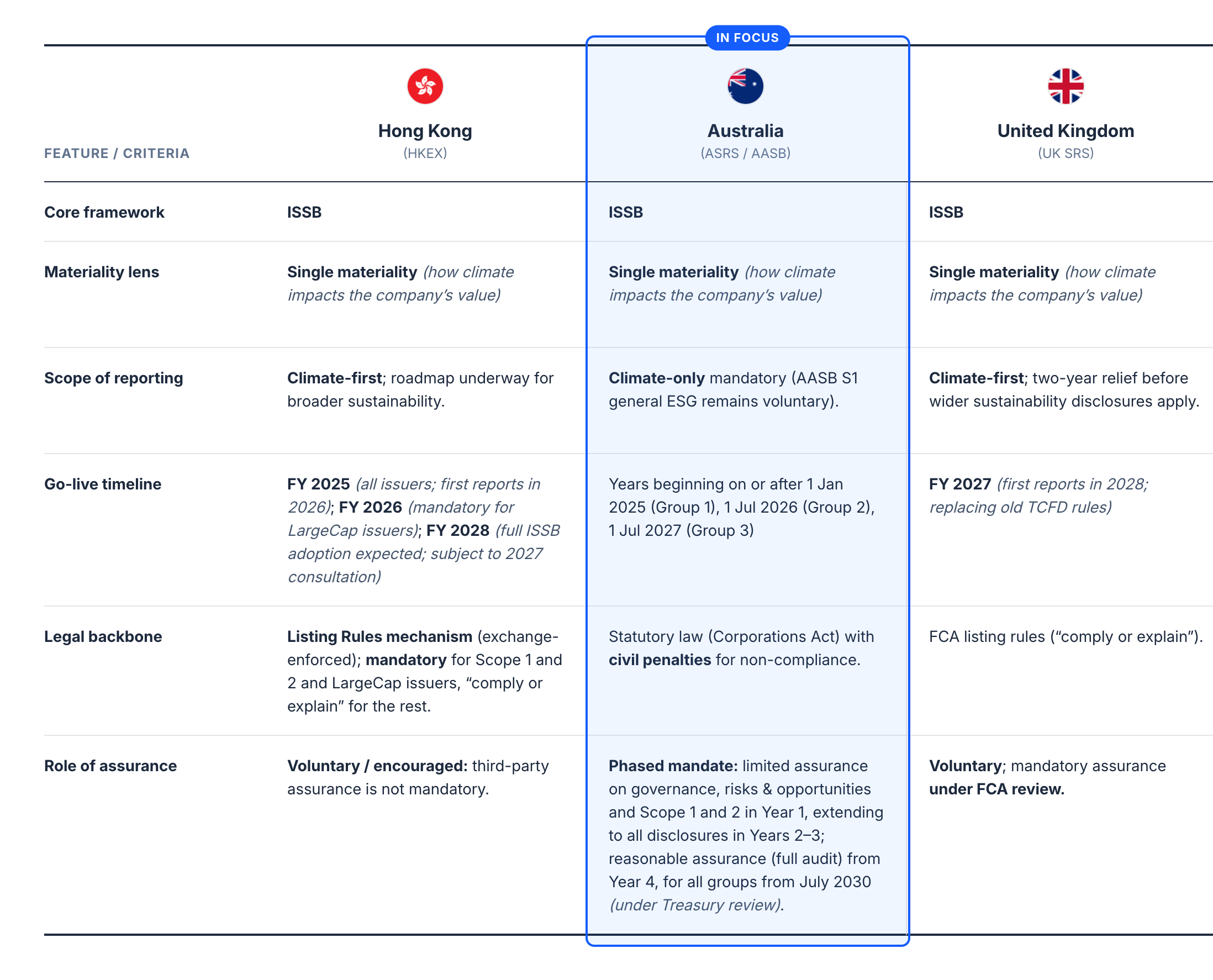
Australia’s climate reporting rules largely mirror other ISSB-based regimes. The most significant differences in the Australian context are that entities are not required to disclose industry-based metrics, and that the Corporations Act specifies the climate scenarios that must be used in scenario analysis. Disclosures prepared under AASB S2 therefore map closely onto IFRS S2-based reports in other markets.
Does AASB S2 apply to portfolio companies?
Yes, if the company prepares an annual financial report under Chapter 2M of the Corporations Act and meets one of three thresholds in section 292A. That includes large proprietary companies, not just listed entities. Small proprietary companies that do not prepare and lodge annual financial reports are generally outside the regime.
The three thresholds are:
- Size test: meeting two of three measures of consolidated revenue, consolidated gross assets and employees.
- Emissions test: being a registered corporation with reporting obligations under the National Greenhouse and Energy Reporting (NGER) Act 2007.
- Asset test: registered schemes, registrable superannuation entities and retail CCIVs above an asset threshold.
The size test is measured on a consolidated basis: the company plus the entities it controls. Revenue is measured for the financial year; gross assets and employees at the end of it (section 1707B).
Most private equity funds are unregistered wholesale funds, so the asset test does not usually apply to the fund itself. The obligation sits with portfolio companies that meet the thresholds. ASIC's Regulatory Guide 280 Sustainability reporting (RG 280) sets out the tests in full.
Which group is my portfolio company in, and when does it report?
Obligations are phased in across three groups, based on the first financial year beginning on or after each start date.
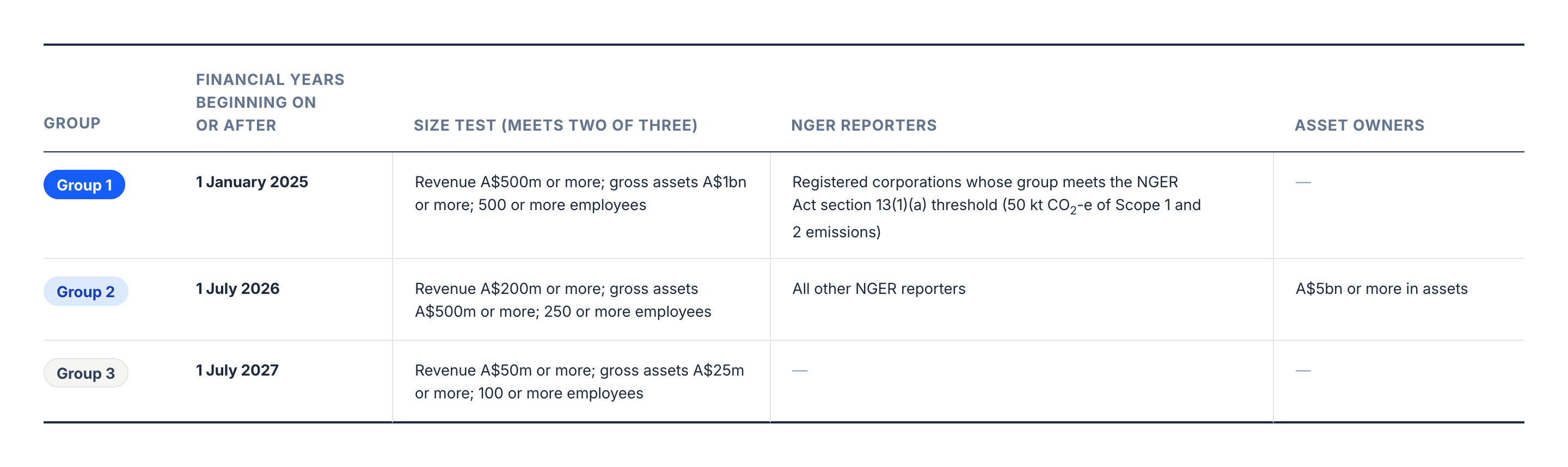
Registered schemes, registrable superannuation entities and retail CCIVs are not in Group 1; they enter in Group 2 or Group 3 (RG 280.37).
Reports are lodged with the annual financial report: within three months of year end for disclosing entities, registered schemes and registrable superannuation entities, and within four months for other reporting entities.
In practice:
- Group 1: first reports were lodged in 2026, without Scope 3 emissions. Second reports, due in late 2027, include Scope 3 for the first time.
- Group 2: a company with a 30 June year end is already in its first reporting year. A 31 December year end starts with calendar 2027 and reports in early 2028.
- Group 3: first reporting years start from 1 July 2027, so first reports are due from late 2028.
What has to be disclosed?
The sustainability report contains climate statements prepared under AASB S2, any notes, and a directors' declaration. The climate statements follow the four IFRS S2 pillars:
- Governance: how the board oversees climate-related risks and opportunities, and management's role in assessing and managing them.
- Strategy: the climate-related risks and opportunities identified over the short, medium and long term; their effects on the business model, value chain and financial performance; how the company is responding, including any transition plan and adaptation measures; and the resilience of the strategy under climate scenarios.
- Risk management: how climate-related risks are identified, assessed, prioritised and monitored, and how this is integrated into overall risk management.
- Metrics and targets: Scope 1 and 2 emissions from the first year and Scope 3 from the second; assets and business activities vulnerable to transition and physical risks or aligned with opportunities; investment deployed towards them; internal carbon prices; climate-linked executive remuneration; and any climate-related targets.
A Group 3 entity with no material climate-related financial risks or opportunities can instead state this and explain how it reached that conclusion (section 296B).
On emissions measurement, entities may use a method required by a jurisdictional authority, such as the NGER scheme, instead of the GHG Protocol (AASB S2 paragraph B24). Scope 2 is disclosed on a location-based basis.
Which climate scenarios does AASB S2 require?
Unlike IFRS S2 and other implementations of ISSB climate reporting standards, Australian law prescribes the scenarios. Section 296D(2B) of the Corporations Act requires climate resilience to be assessed against at least two: a 1.5°C increase in global average temperature above pre-industrial levels, and an increase well exceeding 2°C.
ASIC considers that 2.5°C or higher would well exceed 2°C, and warns that a higher-warming scenario below 2.5°C risks non-compliance (RG 280.99). The NGFS Net Zero 2050 and Current Policies scenarios are one way to meet both requirements, and intermediate scenarios can be added alongside them. Companies using the NGFS NDCs scenario as the higher-warming case should check its projected warming against the 2.5°C benchmark first.
Companies must also explain how and when the analysis was carried out: the scenarios and their sources, time horizons, scope of operations covered and key assumptions (AASB S2 paragraph 22(b)). Unwritten’s strong audit trail and clear outputs are specific to each scenario and time horizon.
When does assurance apply?
Sustainability reports must be audited or reviewed under the AUASB's ASSA 5000, with the scope and level of assurance phased in by ASSA 5010 (as amended in December 2025). The phasing is the same for every group, counted from its first reporting year:
- Year 1: limited assurance over governance, the climate-related risks and opportunities identified (AASB S2 paragraphs 9(a), 10(a) and 10(b) only), and Scope 1 and 2 emissions.
- Years 2 and 3: limited assurance over all disclosures, including scenario analysis, transition plans, risk management and Scope 3.
- Year 4 onwards: reasonable assurance over all disclosures.
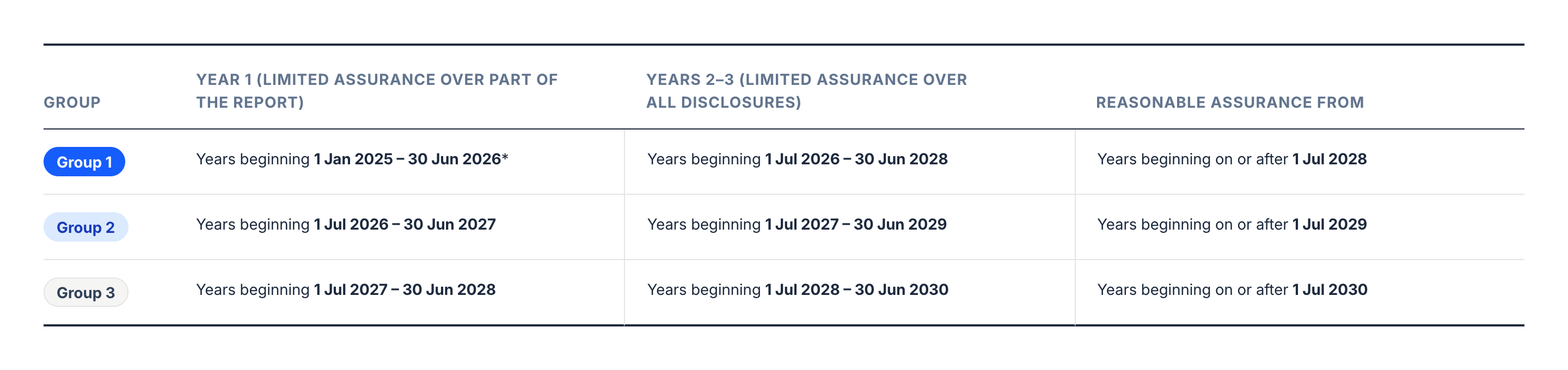
*Group 1 entities whose financial year starts between January and June, such as a 31 December year end, have two Year 1 periods. A Group 3 statement of no material climate-related risks or opportunities follows the phasing for other strategy disclosures, so it is assured from Year 2. From financial years beginning on or after 1 July 2030, reasonable assurance applies to every group.
Because scenario analysis and asset vulnerability metrics come under assurance from Year 2, the methodology behind them needs to be documented and repeatable from the first report.
Modified liability. For financial years beginning between 1 January 2025 and 31 December 2027, statements about Scope 3 emissions, scenario analysis and transition plans are protected: only ASIC, or criminal proceedings, can bring action over them (section 1707D). Other forward-looking climate statements are protected only for financial years beginning in calendar 2025. Over the same 2025–2027 period, directors declare that the entity has taken reasonable steps to ensure the report complies with the Corporations Act and AASB S2 (RG 280.58).
Is your portfolio company out of scope? They may still be asked for climate data…
Portfolio companies below the thresholds are still likely to receive climate data requests. In-scope customers must report Scope 3 emissions from their second reporting year, which covers emissions in their supply chains. Lenders and private equity owners also need climate information for their own reporting.
Requests typically cover energy use and emissions, exposure of key sites to physical hazards, and the climate-related risks a supplier faces. The Treasury consulted from August to October 2026 on options that include limiting value chain data requests, but nothing has been legislated. Preparing a consistent, documented answer once is usually faster than responding to each request separately.
What this means for private equity owners
For global or local private equity firms with Australian holdings, AASB S2 turns climate risk from a voluntary portfolio exercise into a statutory obligation for in-scope companies. The most demanding part is not the governance narrative but the analysis behind it: identifying physical and transition risks across sites and value chains, testing resilience under the two mandated scenarios, and quantifying the assets and business activities vulnerable to each risk. Three points matter most:
- Consistency: using one methodology across the portfolio makes results comparable and simplifies reporting to investors.
- Timing: portfolio companies entering Group 2 or Group 3 need data, scenarios and governance in place before their first reporting year closes.
- Exit readiness: an assured, repeatable climate disclosure can form part of the information that new sponsors review in due diligence.
What is changing?
Four developments are worth tracking, as of November 2026:
- Group 3 thresholds: the 2026–27 Federal Budget proposed raising the large proprietary company thresholds, which would also lift the Group 3 thresholds to A$100m revenue and A$50m gross assets, with the 100-employee threshold unchanged. This has not been legislated and its start date is not confirmed.
- Assurance: The Treasury's August–October 2026 consultation included options to keep limited assurance permanently, defer reasonable assurance to 2035, or require it only for mature metrics such as Scope 1 and 2. None has received Government approval, and The Treasury has said the changes will not affect 2026–27 reporting.
- AASB S2025-1: effective for periods beginning on or after 1 January 2027, with early adoption permitted, this amendment clarifies the relief for jurisdiction-required measurement methods such as NGER, allows entities to keep using global warming potential values required by a jurisdictional authority, and clarifies the relief for some Scope 3 Category 15 (investment-related) emissions.
- Statutory review: a review of the regime is due to begin as soon as practicable after 1 July 2028.
How Unwritten supports companies and private investors with AASB S2 reporting
Unwritten identifies and quantifies physical, transition and nature risk in a single platform, built for the analysis behind the strategy, risk management and metrics disclosures:
- Risk identification: physical and transition risks quantified at site, company and portfolio level, as a starting point for the risks, impacts and value chain disclosures.
- Scenario analysis: results under both mandated scenarios, 1.5°C and well exceeding 2°C, specific to each scenario and time horizon, so the scenarios, sources, time horizons, scope and assumptions needed for disclosure come directly from the platform.
- Adaptation: site-level adaptation measures for each site and hazard, built into company-specific resilience plans.
- Risk management: a consistent, documented process for identifying and assessing climate risks that can be repeated each year, with results exported into existing enterprise risk frameworks and risk registers.
- Asset vulnerability: the assets and business activities exposed to physical and transition risk, taken from the scenario analysis and exportable to Excel in one click.
- Drafting: AI reporting agents that ingest data in any format and produce first drafts of the climate resilience and metrics disclosures for review.
Our free AASB S2 Guided Template maps each disclosure question to the relevant AASB S2 paragraphs, with guidance and sample responses. To discuss your portfolio's reporting, contact support@unwritten.co.
Frequently asked questions
Do private companies need to report under AASB S2? Yes, if they prepare an annual financial report under Chapter 2M of the Corporations Act and meet one of the size, emissions or asset thresholds. That includes large proprietary companies.
When does Group 2 reporting start? For financial years beginning on or after 1 July 2026. Companies with a 30 June year end are in their first reporting year now, with reports due by 30 September or 31 October 2027.
What climate scenarios does AASB S2 require? At least two: a 1.5°C scenario and one well exceeding 2°C. ASIC treats 2.5°C or higher as meeting the second.
Do portfolio companies need to report Scope 3 emissions? In-scope companies report Scope 3 from their second reporting year. Out-of-scope companies may still be asked for data by customers, lenders and investors.
Is AASB S2 reporting assured? Yes. Limited assurance covers governance, identified risks and opportunities, and Scope 1 and 2 emissions in Year 1, extends to all disclosures from Year 2, and becomes reasonable assurance from Year 4.
Access the Guided Template here →
About Unwritten
Unwritten is a UK-based climate and nature risk platform for investors, corporates and advisors. It assesses physical, transition and nature risk at fund, company and site level. Its customers span private equity and infrastructure investors, as well as private and public companies on every continent.
Unwritten combines proprietary risk models with AI to turn complex data into clear, business-specific outputs. It ingests data in any format, identifies what is material to each company, and drafts disclosures in minutes. This frees teams to go beyond compliance: managing risk, building resilience and protecting value across portfolios and operations.

7 Tufton Street, London, SW1P 3QB
© 2026, Orderly Transition Ltd.
Investors


