Masterclass: Climate risk due diligence tips from experts and practitioners
Climate risk due diligence tips from experts and practitioners
Online Webinar
2nd July 2025
WATCH RECORDING
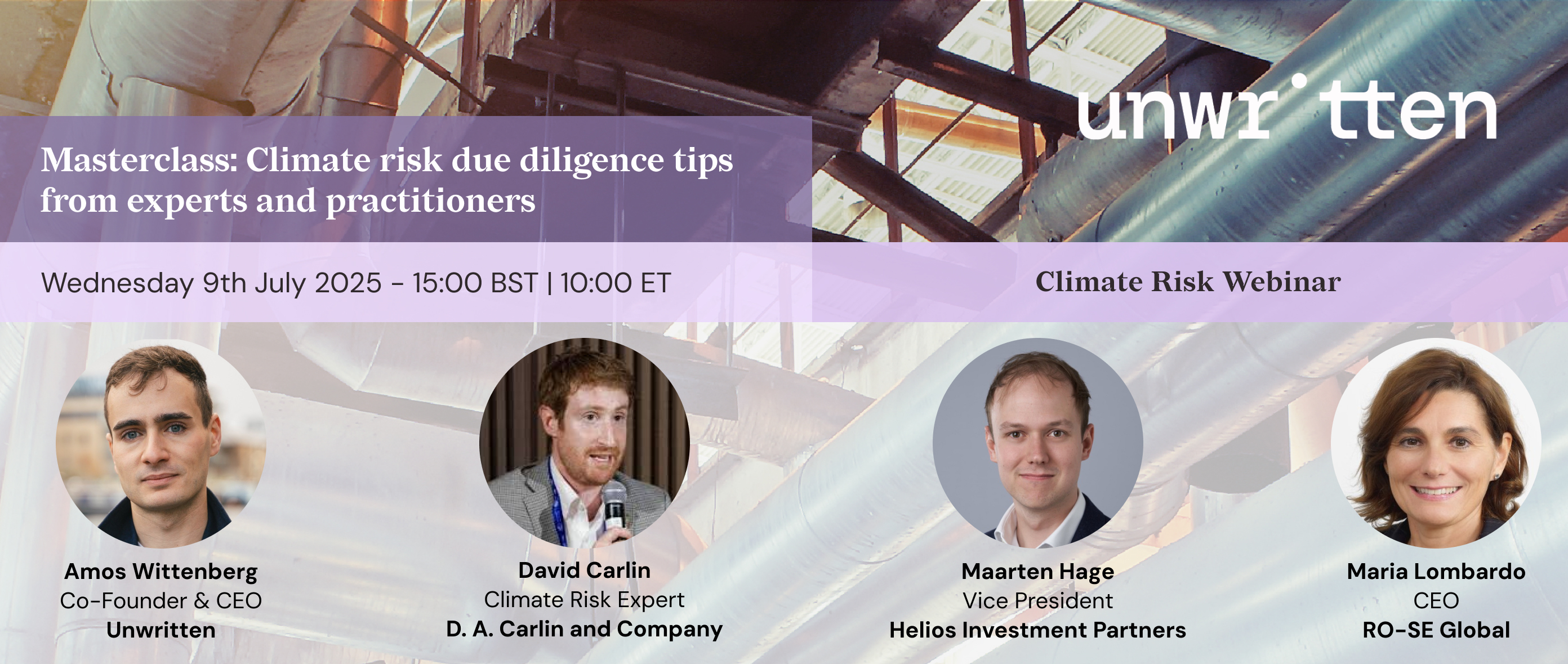
Unwritten, the climate risk platform for private markets, hosted a masterclass on climate risk due diligence for investors. Hosted by Amos Wittenberg, the session brought together David Carlin (Climate Risk Expert, D.A. Carlin & Company), Maarten Hage (VP Climate, Helios Investment Partners) and Maria Lombardo (Founder and CEO, RO-SE Global; former Global Head of ESG Advisory and Sustainable Finance, Standard Chartered). The panel examined how investors can turn climate data into decision-useful financial insight at every stage of due diligence.
Key takeaways
- Assessing climate risk is now a minimum entry criterion of fiduciary duty. The panel noted that legal challenges on fiduciary duty and duty of care increasingly focus on failure to address knowable risks. Trends demonstrate that new climate requirements are emerging well beyond Europe, including in Singapore, Hong Kong, Qatar, the UAE and Kuwait.
- Climate risk analysis must pass the 'analyst test'. If the information wouldn't change a financial analyst's decision on a deal, it isn't decision-useful. Investors should start from the decision, then choose the data, tools and mix of qualitative and quantitative methods that inform it.
- Materiality should set the depth of climate due diligence. At Helios, Africa's largest private equity investor, a business with around 5,000 distributed battery charging and swapping points carried physical risk, but no single storm was business-critical. By contrast, a fresh produce business raised drought and extreme heat risks that could decide whether to invest at all.
- Climate risk lands with decision makers when it is framed in their language. Discussions ought to frame climate risk as cost of capital and EBITDA margin for CFOs, supply chain reliability for procurement heads and shareholder value for boards. Sales teams are more convinced by calculating how climate-driven defaults, such as those caused by drought, could hit a client's loan book.
How should private equity investors carry out climate risk due diligence?
The panel described a process that starts with materiality, scales the analysis to the size of the risk and ends with action.
Scaling analysis from checklist to specialist
The panel walked through three levels of analysis, each with more time and budget than the last. The first is an internal checklist based on in-house expertise. The second is a climate risk platform such as Unwritten, which tracks hazards under standard temperature scenarios and keeps up with policy developments. The third is bespoke insight from experts, such as agronomists, for risks that are critical to the investment case.
From reporting to detection to action
Good workflows beat good analytics: climate tools succeed when they help users complete a task, not when they produce more information. Unwritten is built to move users from reporting through to detecting material risks and acting on them, including cost-assessed mitigation actions at asset level.
Transition risk, scenarios and standards
The rollback of climate policy is itself a transition risk: losing a renewables incentive can matter as much as a carbon tax on oil and gas. Scenario analysis is not a prediction of future energy prices, but it is a powerful sensitivity analysis. One panellist likened relying on a single scenario to a doctor checking only your hearing during a full physical. They also stressed that ISSB, GRI and the ESRS share a common core of good practice, so preparing now will pay off whichever standards apply.
About Unwritten
Unwritten is a London-based climate risk platform for private markets. Its platform, Unwritten AI, helps private equity and infrastructure investors assess physical, transition and nature risk at fund, portfolio company and site level.
The platform uses artificial intelligence to automate complex climate risk data workflows and drive value-creation opportunities for private markets investors, asset managers and corporate risk leaders. Unwritten helps leaders move beyond minimum compliance to actively manage risk and build operational resilience that creates value at the PortCo level.

7 Tufton Street, London, SW1P 3QB
© 2026, Orderly Transition Ltd.