Webinar — Shifting Expectations: LPs and Climate Risk
Shifting Expectations: Takeaways from Unwritten's Webinar on LPs and Climate Risk
Online Webinar
8th October 2025 | 17:00 BST
WATCH RECORDING
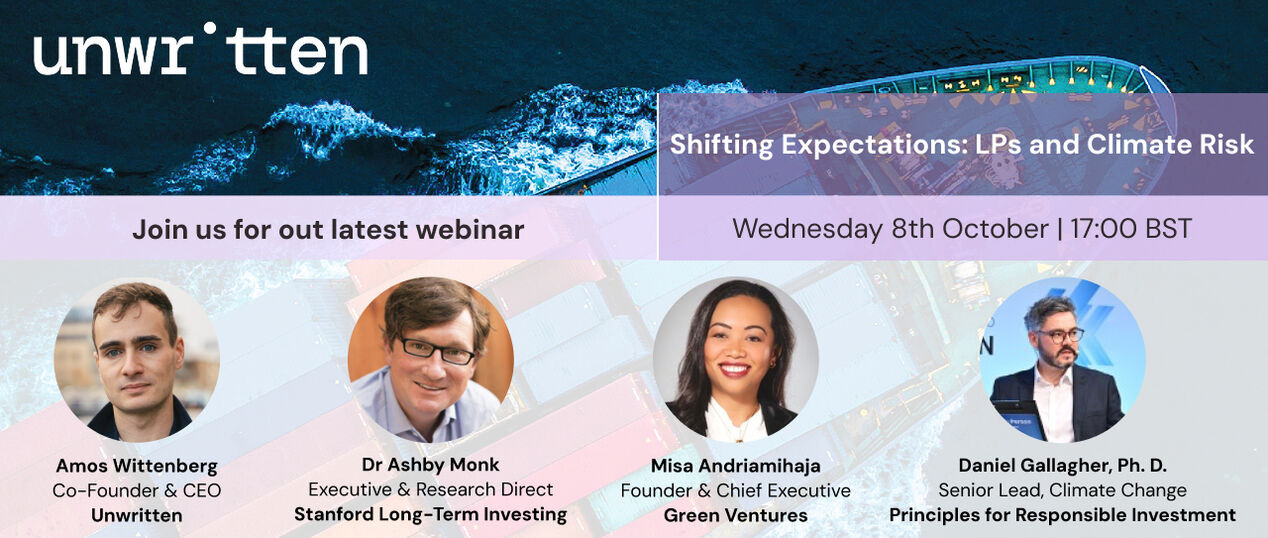
Unwritten, the climate risk platform for private markets, hosted a webinar on what limited partners (LPs) expect from general partners (GPs) on climate risk. Hosted by Amos Wittenberg, the session launched Unwritten's report Shifting Expectations: Limited Partners and Climate Financial Risk, which covers the 100 largest LPs by private markets allocation. The session brought together Dr. Ashby Monk (Executive Director, Stanford Long-Term Investing), Dr. Daniel Gallagher (Head of Climate Risk and Net Zero Implementation, UN Principles for Responsible Investment) and Misa Andriamihaja (Founder and Chief Executive, Green Ventures Capital; former Private Markets Lead, IIGCC).
Key takeaways
- Climate risk assessment is now a mainstream LP requirement. Unwritten's research found that 68 of the world's 100 largest LPs publicly require managers to assess climate-related financial risks in the investment process, and a further four expect it. Many LPs build climate risk into external manager due diligence.
- US LPs lag on headline requirements but still treat material climate risk as a fiduciary concern. Around half of large US LPs require or expect climate risk assessment, compared with well over 80% in most other regions. Statements from US LPs still recognise ESG factors that are material to long-term returns and risk.
- LP requirements for climate risk assessment now outstrip those for emissions targets. In total, 72 of the 100 largest LPs require or expect climate risk assessment, but only 62 expect or recommend an emissions target, and LPs use softer language for targets. Unwritten sees this as a shift from double materiality towards single materiality: the risk climate change poses to holdings, rather than the holdings' contribution to climate change.
- Asset owners need climate risk expressed in financial terms, not scores. Speakers argued that investors invest in risks, not uncertainties. A ‘yellow’ climate rating gives an investment committee little to act on, while a discount rate it can apply in a model does.
- Physical risk and resilience now stand alongside decarbonisation in asset owner strategy. One speaker described asset owners as entering a ‘response’ phase. In this phase they engage managers on avoiding climate-related losses and on finding growth opportunities in adaptation.
Which trends have shaped the changing LP expectations?
The panel agreed that LPs increasingly expect GPs to integrate climate risk into investment decisions rather than treat it as a reporting exercise. Three themes shaped that view.
Long-horizon liabilities make climate a fiduciary issue
Asset owners hold around $140tn across pension funds, sovereign funds, endowments, foundations, insurers and family offices. Some of their liabilities stretch beyond 100 years. The panel explained that these investors manage climate risk to meet their obligations, not to solve climate change. They do it by tilting portfolios, divesting from exposed industries and, for example, moving real estate away from regions where property insurance is becoming unavailable.
From disclosure to commitments to response
The discussion traced three phases since the TCFD recommendations in 2017. First came awareness and frameworks: by 2020, four-fifths of asset owners had board oversight of climate. Then came targets and commitments, and now comes a response to physical impacts that are already locked in. Uneven policy is reshaping capital flows: in the first half of the year, clean energy investment fell 36% in the US but rose by more than 60% in Europe.
Larger focus on climate solutions allocations
Over the past two years, LPs have moved beyond stated ambition to dedicated allocations for climate solutions. Alongside this, the IIGCC’s Net Zero Investment Framework for private equity and private credit treats portfolio company emissions and board-level oversight of climate risk as core criteria.
About Unwritten
Unwritten is a London-based climate risk platform for private markets. Its platform, Unwritten AI, helps private equity and infrastructure investors assess physical, transition and nature risk at fund, portfolio company and site level.
The platform uses artificial intelligence to automate complex climate risk data workflows and drive value-creation opportunities for private markets investors, asset managers and corporate risk leaders. Unwritten helps leaders move beyond minimum compliance to actively manage risk and build operational resilience that creates value at the PortCo level.

7 Tufton Street, London, SW1P 3QB
© 2026, Orderly Transition Ltd.